



The water in a swimming pool is constantly exposed to microbes and bacteria, so it’s essential to carry out proper pool treatment to keep it clean and safe for users. Learn how to perform saltwater pool treatment by understanding how salt electrolysis works and its main advantages.
Swimming pool water disinfection
Even if a pool appears clear and clean, the water can still contain bacteria and microbes harmful to human health. These can cause intestinal problems, skin and eye irritation, or even lung infections.
To prevent this, an appropriate pool treatment is required to maintain the main water properties and disinfect it by eliminating all microorganisms.
Today, there are several suitable systems for disinfection and pool treatment, such as chlorine treatment, ultraviolet treatment, and saltwater pool treatment, also known as salt electrolysis disinfection, among others.
Saltwater pool treatment
Saltwater pool treatment, also referred to as salt electrolysis disinfection, has long been successfully used in both public and private pools.
Currently, more than 50% of private pools in Portugal use saltwater pool treatment. The process is very simple: just add a small amount of salt (table salt is suitable) directly into the pool water.
The salt cell is installed in the pool’s circulation system, and the water is treated through electrolysis.
What is salt electrolysis?
Salt electrolysis refers to the process of breaking down salt into chlorine, which is then used to disinfect the pool.
This pool treatment is a more economical and eco-friendly way to disinfect pool water, making it safe for swimming and free from bacteria and microbes.
How does salt electrolysis work in practice?
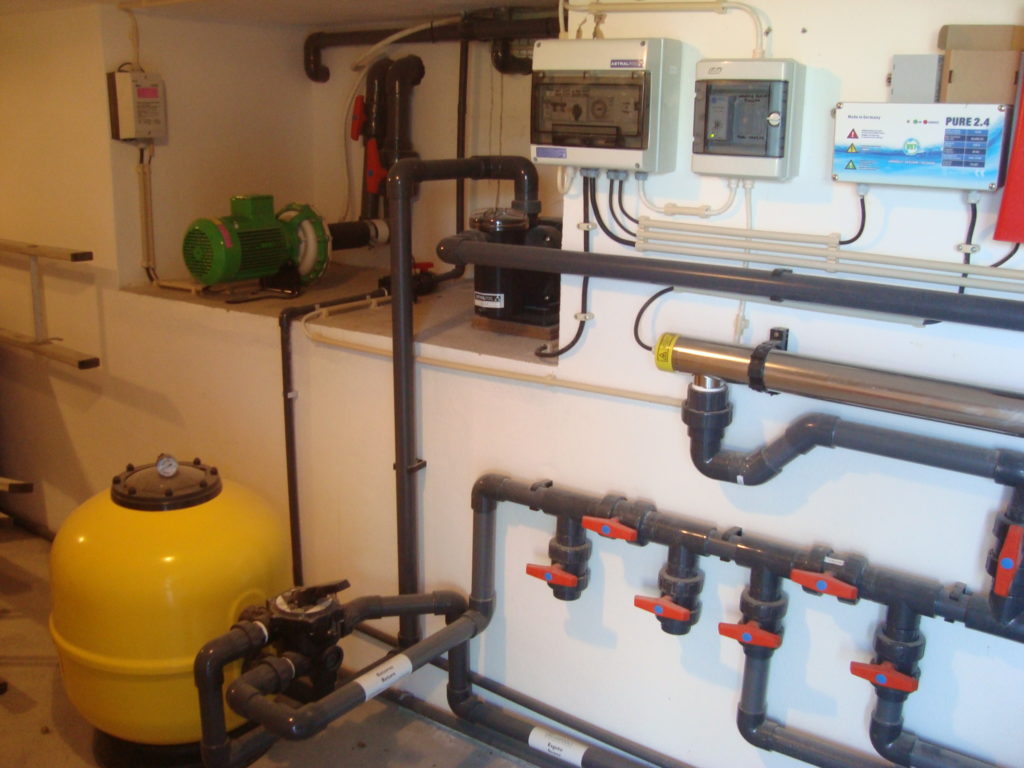
To perform salt electrolysis, you need a specific device installed, and then salt is added to the water to remove impurities. Typically, around 4 grams of salt are used per 1,000 litres of water.
This saltwater pool treatment is highly effective, as it transforms salt molecules into a disinfectant that eliminates bacteria, microbes, and other fungi that may be present in the pool water.
Once the salt is dissolved in the pool, the installed system generates a controlled electric current (via an electrode), converting the salt into chlorine. This ensures the water remains sanitised through the action of chlorine.
At the end of the process, after the impurities have been oxidised, the chlorine is reconverted into salt—meaning the salt remains in the pool water continuously.
With this pool treatment, you only need to monitor the salt level along with the water’s alkalinity and pH parameters.
Main advantages of saltwater pool treatment
Saltwater pool treatment offers the following advantages:
- Cost-effective: No need to purchase chlorine regularly.
- Automatic: Water disinfection occurs automatically whenever the salt chlorinator is operating (this equipment is sized based on the pool volume and usage).
- Eco-friendly and healthier: The pool water is mixed with sea salt, eliminating red eyes, skin irritation, and other discomforts. This is especially beneficial for families with children.
- No chlorine smell: The absence of chlorine odour ensures greater comfort for users and prevents allergic reactions linked to chemical chlorine.
If you’d like more information about saltwater pool treatments, contact the Dreampools team. With nearly four decades of experience in the field, we can help you keep your pool clean and chlorine-free. Visit www.dreampools.en, call +351 282 792 593 or email us at geral@dreampools.pt.